
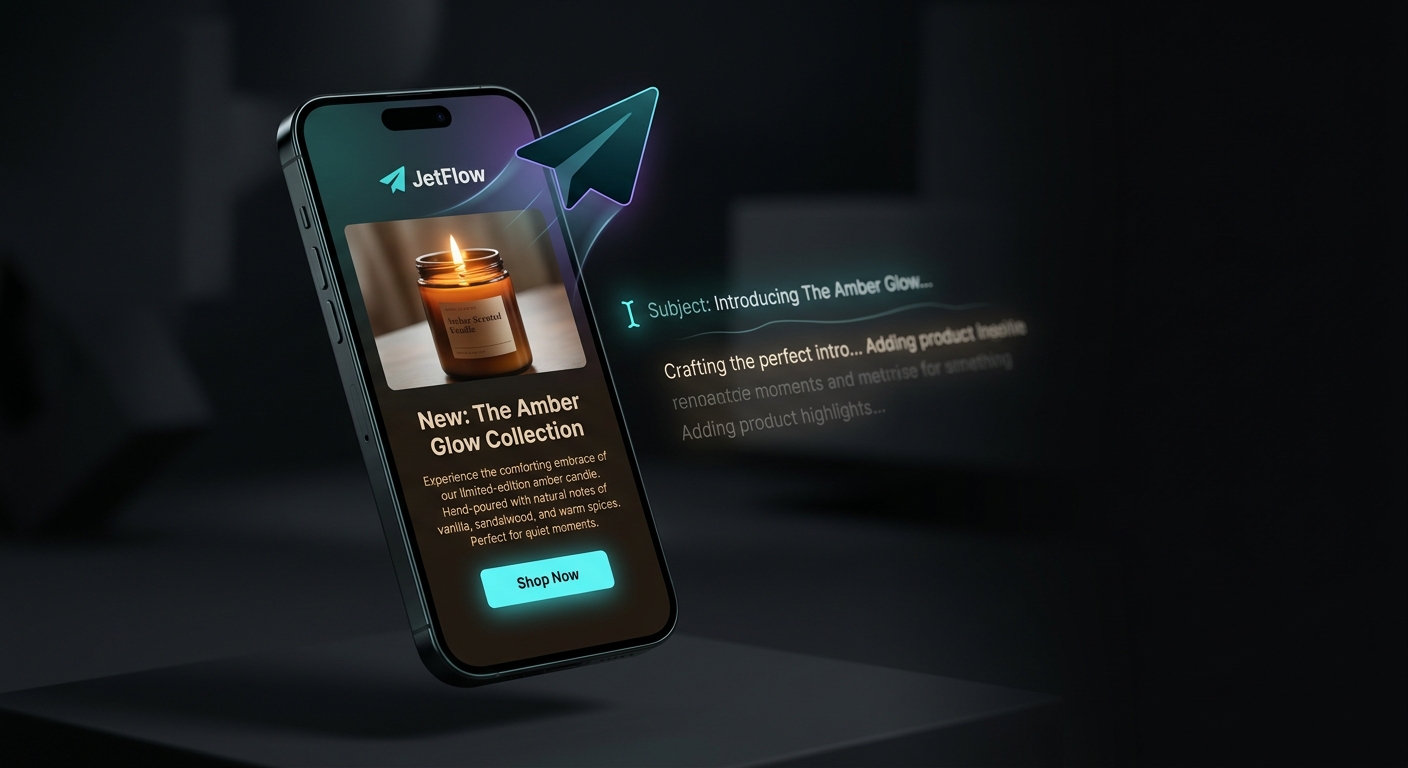
If you run a Shopify store, an AI email copywriter is the tool that drafts your campaign and flow emails so you stop dreading the blank page. The good ones write a subject line, body copy, and a call to action in seconds. The catch is that most of them were built for cold B2B sales, so out of the box they write vague, off-brand email that names no real products and sounds like every other newsletter. The ones worth paying for read your actual catalog, prices, and brand voice, so the draft already mentions your best-seller by name and talks the way you talk.
This guide is about picking one that fits an ecommerce store, not a sales team. You will see why generic AI copy comes out bland, what good store email copy actually looks like, a checklist for choosing a tool, and an honest read on Copy.ai, Klaviyo AI, and where a tool like JetFlow fits.
What does an AI email copywriter actually do?
At its simplest, it turns a short instruction into a finished email draft. You tell it the goal ("promote the summer sale," "win back customers who have not bought in 90 days"), and it returns a subject line, preview text, body, and a button label. Better tools go further and generate a whole sequence, like a three-email launch or a win-back flow, in one pass.
Where they differ is what they know before they start writing:
- Prompt-only writers know nothing about your store. You paste context into a box, they generate from that. Fast, but the output is only as specific as what you typed.
- Brand-aware writers learn your voice from your website, past emails, or a short brief, so the tone is closer to yours.
- Store-data writers connect to your Shopify catalog and pull real product names, prices, and images, so the copy references what you actually sell without you retyping it.
For a store, that last group is the difference between an email you can send after a glance and one you have to rewrite from scratch.
Why does generic AI email copy come out bland?
Because the model is guessing. When a cold-sales tool has no idea what you sell, it fills the gaps with safe, generic language: "our latest collection," "shop now for great deals," "don't miss out." None of that is wrong, but none of it is yours. It reads like AI because it was written by a model with nothing specific to say.
Two things make copy sound bland:
- No product truth. The email talks about "products" and "collections" instead of "the Marigold linen dress" or "your usual roast, back in stock." Specificity is what makes email feel written for the reader.
- No voice. If the tool never saw how you write, it defaults to a flat, corporate register. A store that is playful on Instagram suddenly sounds like a bank.
The fix is not a cleverer prompt. It is giving the tool your real data and a sample of your voice so it has something true to write about.
What does good AI email copy for a Shopify store look like?
Here is the same brief run two ways. The brief: announce a restock of a sold-out candle.
Generic prompt-only output:
Subject: We're Back!
Preview: Your favorite item has returned

Hi there,

Great news! One of our most popular products is back in
stock. Don't miss your chance to grab it before it sells
out again. Shop now and treat yourself today!

Shop Now
Store-data output (real product, price, and voice):
Subject: The Cedar + Smoke candle is back
Preview: It sold out in 4 days last time.

Hey,

You asked, we restocked. Cedar + Smoke ($28) is back on
the shelf after selling out in under a week. It's the one
that smells like a cabin in October, and we made a smaller
batch this time.

If you want one, I wouldn't wait.

Grab a Cedar + Smoke
The second one is not better because the AI is smarter. It is better because it knew the product name, the price, the fact that it sold out fast, and that your brand writes like a person, not a press release. That is the whole game.
What should you look for in an AI email copywriter?
Run any tool against this checklist before you pay for it:
- Does it read your Shopify catalog? Real product names, prices, and images pulled in automatically beat anything you type by hand.
- Can it learn your voice? From your site, your past emails, or a brief. If the only input is a blank box, expect generic tone.
- Does it write full campaigns and flows, or only single emails? A launch is a sequence. A win-back is a sequence. One-email tools leave the hard part to you.
- Does it design, or just write? Copy in a blank template still needs layout. Tools that generate the on-brand design too save the second half of the work.
- Does it push to where you already send? If you use Klaviyo, you want the draft to land in Klaviyo, not trapped in a separate app you copy and paste out of.
- How easy is it to edit? You will always review before sending. The draft should be editable in seconds, not locked.
If a tool misses the first two, it is a cold-sales writer wearing an ecommerce label.
Are Copy.ai, Klaviyo AI, and Jasper good for a Shopify store?
Short version: they are all capable writers, but they are built for different jobs. Here is an honest read.
- Copy.ai is a strong general copywriting platform aimed at marketing and sales teams. It writes email, but it is not Shopify-native, so you feed it context rather than connecting your catalog. It has no free plan, and the entry Chat plan runs $29 per month (verified on copy.ai in August 2026). Fine if you want a flexible writer for many formats; more work if you just want on-brand store email.
- Klaviyo AI is the closest to store-aware, because Klaviyo already has your data. Klaviyo says its AI is trained on your brand, website, catalog, and profiles, and it generates copy and subject lines inside the Composer. If you live in Klaviyo, its built-in AI is the obvious first thing to try. The gap most stores hit is that it still leans on you to prompt and assemble each campaign rather than planning a month of them.
- Jasper and similar general writers are excellent at long-form and flexible tone, but like Copy.ai they are not ecommerce-native. You are the integration layer, retyping product details every time.
None of these are bad. The question is how much of the work they leave on your plate. A general writer leaves the store context to you. A platform AI writes inside the tool but still waits for you to drive.
Where does JetFlow fit?
JetFlow is the writing and design layer built specifically for Shopify. It reads your store's real products, branding, and data, then generates on-brand campaign emails and popups, and pushes them into Klaviyo where you already send. The idea is to kill the blank page: plan a month of campaigns, generate the copy and the design, review, and send.
It is not a Klaviyo replacement, and it does not pretend to be. Klaviyo stays your sending platform, your list, and your reporting. JetFlow handles the part most store owners actually dread, which is writing and designing the campaigns week after week. If your problem is deliverability or flow logic, an ESP solves that. If your problem is that you have not sent a campaign in three weeks because writing them is a slog, that is the gap a store-aware AI copywriter closes.
How do you keep AI email copy accurate?
This is the part the tool roundups skip, and it matters most for stores. An AI writer can invent a discount you never offered or a claim you cannot back up. A made-up "50% off" in a live send is a real problem, not a typo.
Three habits keep you safe:
- Read every draft before it sends. Non-negotiable. AI gets you the draft fast; approving it is your job.
- Verify the numbers. Check that every price, discount, and product claim in the email is real. Store-data tools help here because they pull real prices instead of guessing, but you still confirm the offer.
- Watch for fake urgency. "Only a few left" should be true. Readers remember when it is not, and it trains them to ignore you.
Used this way, an AI email copywriter is not a shortcut that lowers quality. It is a way to get a specific, on-brand first draft in seconds and spend your time on judgment instead of a blank screen.
If you want to see this in practice, the next step is simple: pick one upcoming campaign you have been putting off, generate a draft from your real catalog, and edit it down. The blank page is the hard part, and it is the part AI is genuinely good at removing.